


[a quick note before we begin]
this is part 4 of a four-part series built on original research — 175 women, one survey, a lot of open-ended honesty.
in part 1, we established that getting dressed right now isn’t about expression. it’s triage.
in part 2, we named the mechanism: autopilot dressing. regulation without pleasure.
in part 3, we opened the medicine cabinet — and found out what women are actually self-prescribing every morning without calling it a prescription.
this is the final course.


click, click, click, clack.
allow me to set the scene.
i’ve been listening to Raye’s “Click Clack Symphony” on a loop that i can only describe as “research.” in the shower. while making coffee. on my morning walks.
the song clicked immediately — half the internet is filming close-ups of their heels hitting pavement like it’s a form of civic duty. but it took a few listens before i caught what was actually underneath it.
dear reader, i gasped. this song is a five-minute dissertation on exactly what we’ve been building toward in this series. and Raye didn’t even need a survey.
because the song doesn’t start with the heels. it starts with this:
“I conquered the odds of being born. But I can’t conquer leaving this house.”
she eats. she sleeps. she scrolls. she works.
and the solution isn’t therapy or a journal or a meditation app. it’s a phone call. a dress. and a pair of heels with something to say.
because the click-clack isn’t just a sound. it’s a decision to be embodied. to take up audible, physical, unmissable space. to announce — with your literal footsteps — that you have arrived somewhere on purpose. and it’s resonating:


the song turned the sound of getting dressed into a symphony. i want to talk about why the data says she’s right.
75% conviction. 6% follow-through.
here’s what surprised me most in this entire study.
i expected women to be skeptical about whether clothing could actually shift how they feel. i expected ambivalence, hedging, a polite shrug. maybe a “sure, i guess” energy.
instead: 75% of women agree that they can “dress themselves into” the version of themselves they need that day.1 not theoretically. on a seven-point scale. with conviction.
and only 7% disagreed.
which means this isn’t a belief problem. it’s a usage problem.
in part 3, we opened the emergency drawer. we asked women what they reach for when they need to feel steady — the non-negotiable, the thing that’s always there. 94% reach for regulation: all black, oversized, matching sets, athleisure. less color. less body. less decision. less risk. only 6% reach for something expressive.
the closet-as-pharmacy is real. but they’ve only been filling one prescription.
they own a piano. they’re using it as a shelf.
one woman wrote, about the year ahead: “i want to get back to finding my style.”
back. as if she once had it and set it down somewhere. between the school drop-off and the laptop opening and the third outfit change that still didn’t feel right — she misplaced herself. and she knows it.
what 'right' actually feels like (it's not what you think).
we asked women: when you wear an outfit that feels “right,” what’s most true?
this was a check-all-that-apply question, which means women could select as many responses as felt honest. here’s what they said:
46% said: i feel more like “myself.”
not more professional. not more appropriate. not more acceptable. themselves.
42% said they feel more attractive. 35% said they feel more confident speaking and taking up space. 34% said they feel calmer and less anxious.
read that list again. clothing isn’t changing their appearance. it’s changing their nervous system. their posture. their willingness to open their mouth in a meeting. the speed at which they stop checking their reflection and start checking their to-do list.
the outfit isn’t describing who you are. it’s drafting who you become.
and 175 women just confirmed it from their closets without ever hearing a single psychology term.
the thing they want most is the thing they won't let themselves have.
so here’s the tension: 75% of women believe clothes work as a tool for identity and emotional regulation. robust agreement.
and when asked what getting dressed should be more about in the year ahead, the number one answer — by a margin that made me put my coffee down — was self-expression. 35%. nearly double the next closest answer.
a reminder — here’s what the girls are doing right now:
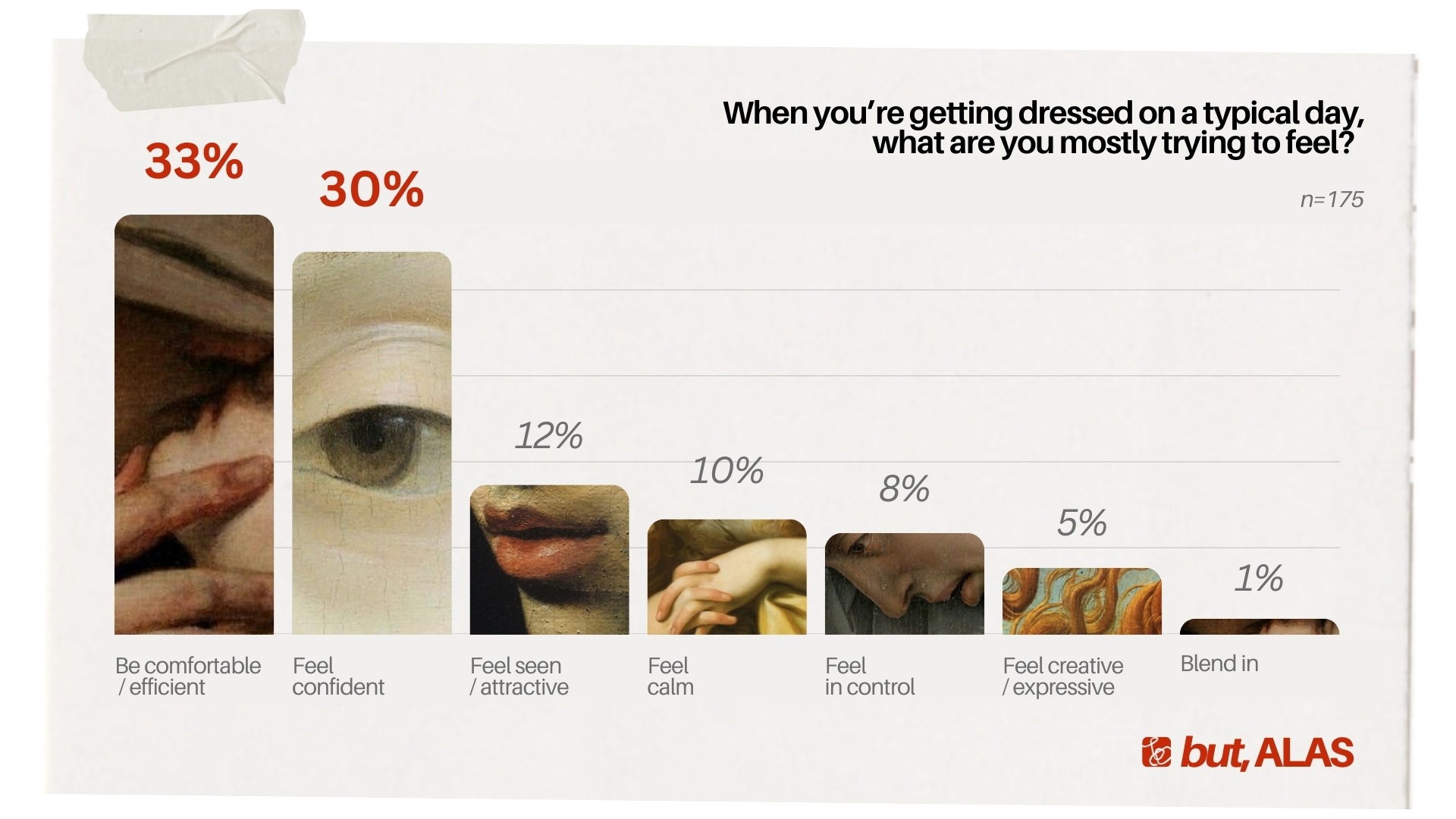
but what they actually desire?
not stability. not ease. not control.
expression.
the thing they’re currently rationing is the thing they most want more of. which is a bit like saying you’re dying of thirst while holding a glass of water because no one told you it was yours to drink.
and here’s where the chicken-and-egg appears: women say they need more energy, more time, more bandwidth to lean into fashion. which — fair. completely fair. but the data is suggesting something the to-do list won’t love: the expression is the energy. the 46% who feel “more like myself” when the outfit is right? that’s not a reward for having a good day. that’s the opening argument for one.
you don’t wait until you feel like yourself to dress like yourself. you dress like yourself until you remember who that is.
what happens when no one's looking (and why it matters more).
even among the women who said they want more expression — nearly two-thirds admitted they’d dress simpler or completely differently if no one were watching.
which tells me we’re still treating clothes like a performance. something you put on for the audience and take off when the curtain closes.
but the data told a different story. women didn’t say they feel like themselves “when other people see the outfit.” they said: when i wear it. full stop. the shift is internal. the audience is optional. the embodiment is not.
this isn’t a tool that activates when someone’s watching. it’s a tool that activates when you put it on. at home. on a tuesday. with nowhere to be and no one to perform for. the click-clack doesn’t need a sidewalk. it needs a body.
the blank permission slip.
one of my favorite responses in the entire study came from a woman who wrote, about the year ahead:
“I want to find my style and step out of my comfort zone.”
and another:
“I want to express my individuality.”
and another, who broke my heart a little:
“I want to try more colors.”
colors. she wants permission to try colors. [this is the part where i stared at my screen for a while.]
this is what i mean when i say the gap isn’t knowledge. it’s permission. women know clothes are powerful. they know expression feels better than regulation. they know the right outfit changes the entire weather system of their day. they said so. in data. unprompted.
but they’re still standing at the threshold — the tool in one hand, the permission slip blank in the other — waiting for a less chaotic tuesday morning before they’ll let themselves use it.
Raye didn’t wait for the permission slip. she called her friends, picked a dress, and let the click-clack write it for her.
what’s your version of “more colors”? the thing you’d wear if the permission slip was already signed?
the prescription i'd actually write.
you don’t need a full wardrobe overhaul. you don’t need a shopping spree or a capsule wardrobe or a pinterest board or a mood board or whatever the algorithm is selling you this week.
start with one outfit. one. the one that makes you feel like yourself — not the regulated, appropriate, please-don’t-look-at-me-too-closely version. the one who’d show up overdressed to a dinner party and be the most interesting person at the table. (you know her. she’s been in there this whole time.)
75% of you already believe this works. the data confirmed it. and Raye — god bless her — wrote the soundtrack.
in verse two, she opens the closet and finds cobwebs on the Manolos. she tries on dresses and feels like an alien in all of them. she turns the music up and pretends it’s fine.
sound familiar?
but then — the call goes out. the dress gets picked. the heels hit the floor. and by the outro, Hans Zimmer’s orchestra is swelling behind the only line that matters:
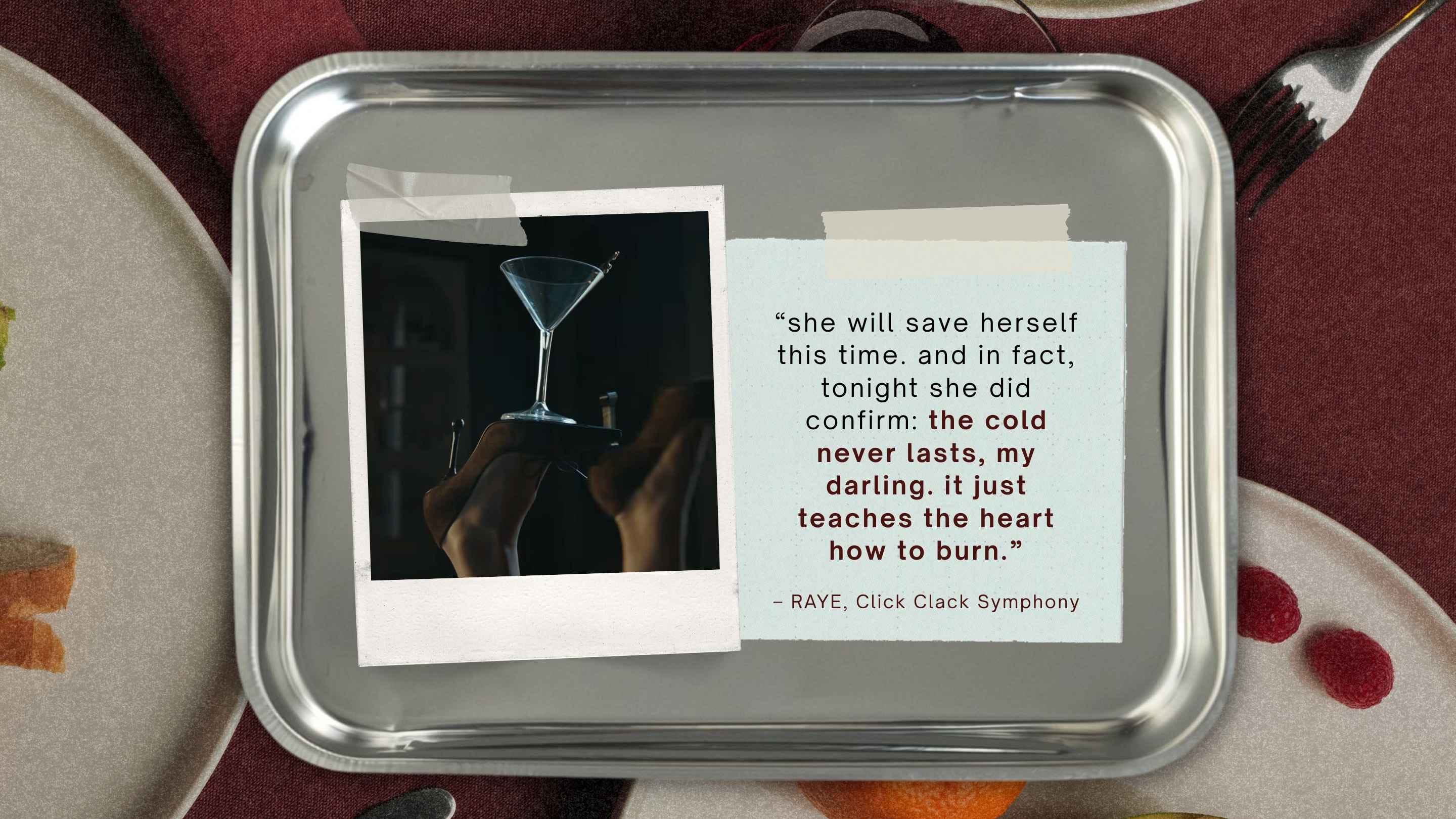
your closet already has the match. light it.
this is the final installment of our first official style study.
and if you’ve been here since part 1: thank you. genuinely. this series started as curiosity and became something I wasn’t expecting.
the next study is about something I’ve been circling for months: what happens to a woman’s wardrobe when her career stops making sense. if you’ve ever stood in front of your closet during a professional identity crisis — I want to hear from you.
subscribe. that’s where the survey link goes first.
Methodology
[ overdressed + overanalyzed ] publishes original research on how women relate to clothing, self-expression, and identity.
All data cited in this piece is drawn from a single study ran in December 2025 with 175 women across the United States, ages 25–44.
This is self-reported survey data collected via an opt-in consumer panel. Findings are directional and illustrative, not statistically generalizable to all women.
[for context, 75% of women can't agree on whether a dress is blue or gold. this number is significant.]
I love this. I find I have different personalities that come out at different times when it comes to dressing. Day to day Professional Izzy loves monochromatic textures and layers. I love simple but beautiful and I take effort to dress and get ready every day even if I’m working from home because it makes me feel confident and so good. When I go to parties and BM for example, the super colorful glitzy Disco Barbie comes out after months of putting my outfits together. But I couldn’t be Disco Barbie every day, she’s the maximalist version of me that comes out to play. I do love architectural pieces and I’d love to lean more into these as a way to express. This article is great!! Thank you!
I've just stumbled across this series and have devoured all 4 parts in one sitting - absolutely fascinating, thank you. Looking forward to more! On the subject of professional dressing, it's something I've been mulling recently. I work in management consultancy in a world where all the men in my office are dressed as identikit navy suit-white shirt-brown shoes clones. For the women it's normal to see everything from suits to dresses to sneakers - and a couple of younger colleagues have said recently that they find it much harder to read what is appropriate for them as a result (they worry they won't get taken seriously etc) whereas those of us who have been around for a bit longer enjoy the apparent freedom this gives us.