


[a quick note before we begin]
this is part 3 of a four-part series built on original research — 175 women across the states, one survey, a lot of open-ended honesty.
in part 1, we established this: getting dressed is no longer about expression. it’s about damage control.
in part 2, we named the mechanism: autopilot dressing. regulation over expression. stability without pleasure.


both pieces kept orbiting a question they never fully answered: what, exactly, are women protecting themselves from?
this is that piece <3
[ the table is set — dig in ]
i dress for “myself.” (sure, babe.)
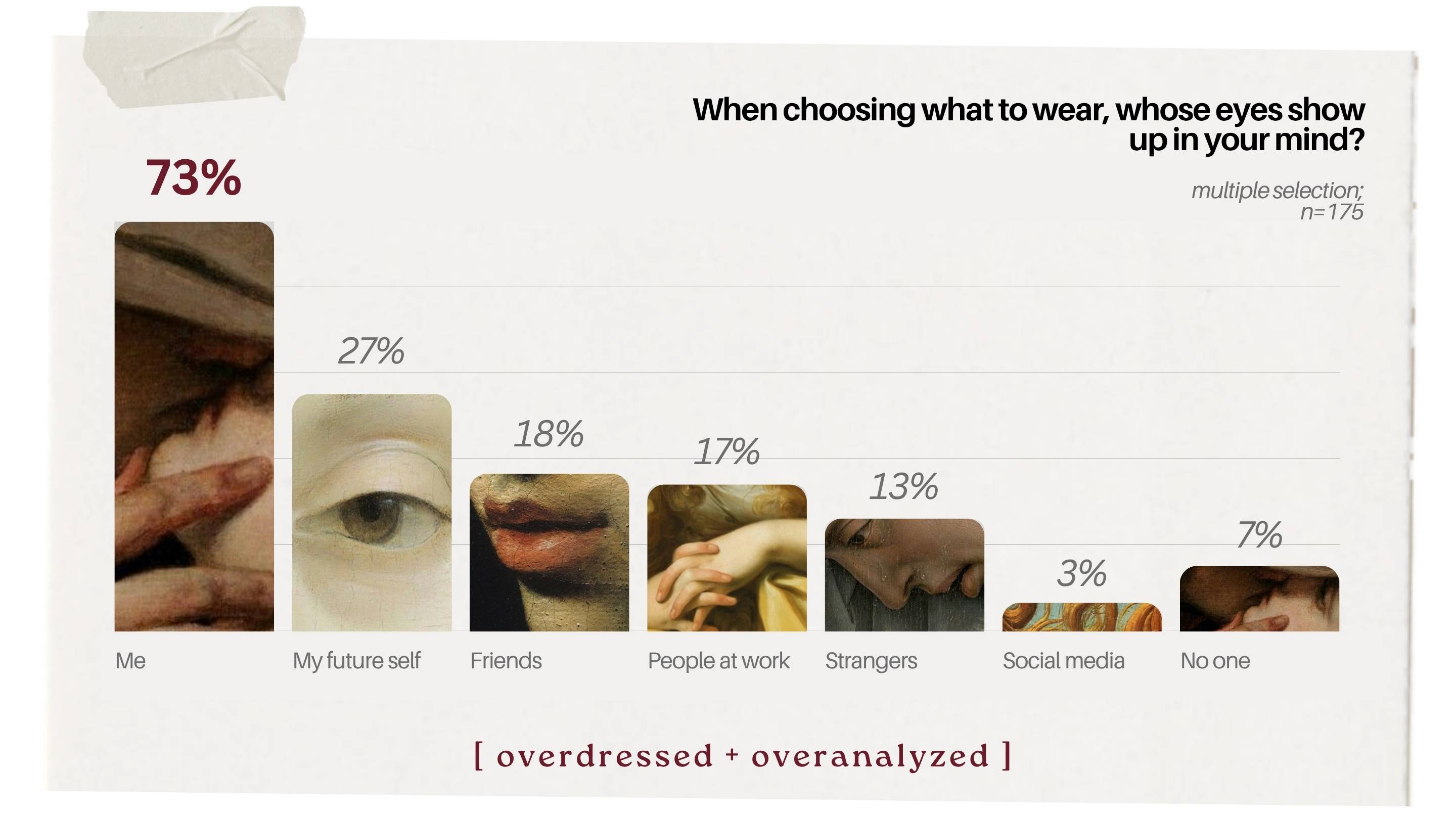
73% of women say they dress for themselves.
not their boss. not their partner. not strangers whose opinions they swear they don’t think about and absolutely do.
the most common answer — by a significant margin — was: me.
and then we asked something gently inconvenient: if no one would see you all day, would you dress differently?
among the women who said they dress for themselves, more than half said yes.
which means the “self” they’re dressing for is already informed. already filtered. already shaped in anticipation of being perceived. iow: they’re dressing for themselves — just not the version of themselves that exists outside of observation.
researchers studying objectification have found that women who simply imagine wearing revealing clothing experience measurable increases in body shame and negative mood. not from being seen. from the possibility of being seen. the observer doesn’t need to be in the room. she’s already been internalized.
so when a woman says i dress for myself and also says i’d dress differently if no one were looking — she’s not being inconsistent. she’s telling you exactly how deep the monitoring goes.
“nothing.” (the nothing is lying.)
when we asked women what their go-to outfit protects them from, the most common answer was nothing.
but nothing was almost never neutral. it was a placeholder. the word reached for when naming the thing would require admitting noticing it exists.
because the thing always shows up, just one sentence later:
“nothing — it makes me blend in.”
“nothing — black hides fat.”
“nothing — I don’t stand out as much.”
“nothing — I just want to be comfortable and hidden.”
read enough of these in sequence and two distinct protection strategies emerge.
the first is external threat management — the ambient awareness of being looked at, assessed, interpreted, approached.
“it protects me from prying, judgmental eyes.”
“it won’t stand out too much and will blend in on a busy day.”
“black protects me from being approached. i don’t like being approached anyway.”
these women aren’t imagining scrutiny. they’ve internalized the data from a lifetime of being on the receiving end of it.
the second is more intimate — managing the experience of existing in a body in public.
“my body.”
“my fat.”
“makes me feel like people can’t see i gained any weight.”
the morning scan that determines what’s permissible today. researchers call this habitual self-monitoring, and it has a measurable cost — it consumes cognitive resources. literally takes up bandwidth that could go elsewhere.
it’s not vanity. it’s labor. and my god, is it costly.
…
there’s one response in particular i kept coming back to:
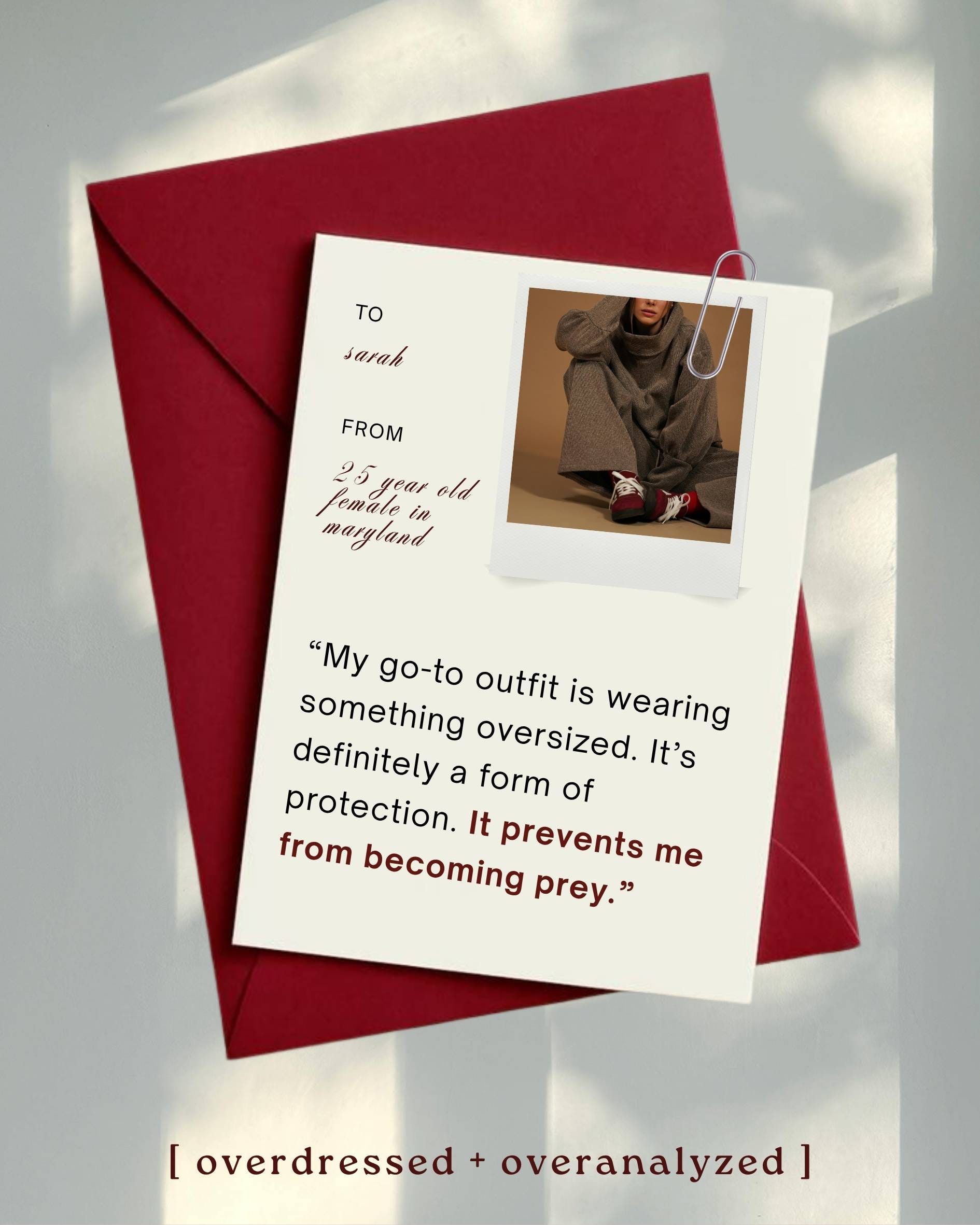
read that again. she didn’t say comfort. she didn’t say confidence. she said prey.
most women, i fear, are running both strategies at once — every morning, without recognizing it as work.
[ is this resonating at all?
i genuinely want to know 🤍 ]
an identity crisis wearing business casual.
there’s a particular kind of inertia that doesn’t feel like inertia. it feels like being reasonable.
it’s the logic of staying in something — a role, a routine, a wardrobe — not because it’s good, but because leaving requires a clarity you don’t currently have and an energy you’re not sure you can afford. so you stay. and you get very good at making staying feel like a choice.
[ i watched a tiktok on the great millennial career crisis a few months ago, and i’ve been hyperfixated on identity and career ever since. ]
right now, 57% of workers describe themselves as “job huggers” — people actively remaining in roles they don’t want, because the alternative is more frightening than the dissatisfaction they already know. six months ago, that number was 45%. among millennial women, 59% have privately hoped something external — a layoff, a restructure, any act of organizational god — would make the decision for them.
career and clothes. two of the primary tools women in this country use to build a sense of identity — and both, right now, in the same kind of crisis.
in both, the person has replaced pursuing something to preventing something.
the dissatisfied worker doesn’t dream about what’s next — she calculates what she can afford to lose.
the dissatisfied dresser doesn’t imagine what she’d love to wear — she calculates what won’t draw attention, won’t require energy, won’t backfire.
burnout branded as adulthood™.
the closet as pharmacy
we asked women what they reach for when they need to feel steady. the answers arrive in a very particular order:
40 women: all-black. less color.
35 women: oversized / hidden. less body.
31 women: a matching set. less decision.
31 women: athletic / athleisure. less effort.
20 women: elevated basics — blazer, coat, boot. less risk.
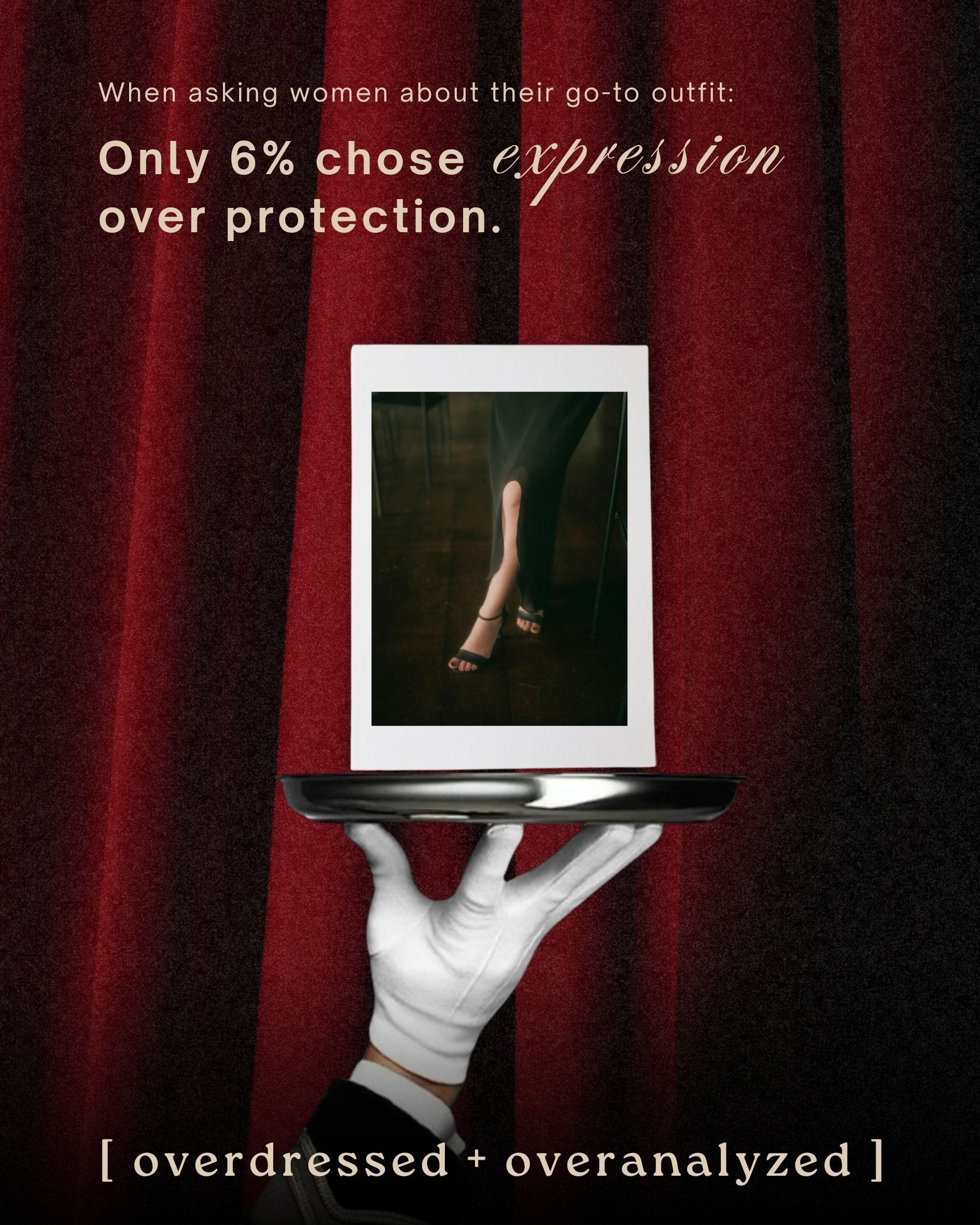
only eleven women — 6% — said their emergency outfit is a statement piece or form of expression.
every category is a variation on the same theme: subtraction. but it’s a particular kind of subtraction.
there’s a concept in psychology called enclothed cognition — the idea that clothing doesn’t just signal identity to others, it activates something in the wearer. in one study, people who put on a white coat and were told it was a doctor’s coat performed measurably better on attention tasks. same coat, described as a painter’s coat? no effect. it wasn’t the fabric. it was the meaning.
which means the emergency outfit isn’t just armor. it’s a cognitive tool.
all-black isn’t just hiding — it’s activating steady.
the matching set isn’t just easy — it’s activating in control.
the oversized hoodie isn’t just comfortable — it’s activating safe enough to function.
these women have built a pharmacy of psychological states they can put on. and the fact that 94% are reaching for regulation and 6% for expression tells you exactly where the threshold of capacity is.
staying put has a very specific wardrobe. and it is very good at its job.
play dies quiet.
the punchline had been circling this entire survey. but for me, it landed with the responses to one question:
what does your go-to outfit keep you from becoming?
“it keeps me from being creative.”
“my self expression.”
“from wearing bolder pieces.”
“i tend to buy the same exact outfit over and over, like a uniform.”
creativity is usually the first thing to go. not because it’s unimportant — because it’s the easiest to rationalize losing. you can reframe it as efficiency. as maturity. as having your priorities straight.
but what’s actually happening: the aesthetic channel — the part of dress that’s about play, desire, risk, self-invention — is being slowly shut down in favor of the management channel — the part that’s about preventing misreading. you can run both at the same time, for a while. but eventually management takes all the bandwidth, and the aesthetic channel goes quiet.
not with a dramatic exit. just a slow fade that feels, from the inside, like growing up…
the woman doing the watching is you.
“my go-to outfit does hold me back from accepting myself as i am by hiding myself rather than embracing. it gives a sense of dressing intentionally with confidence — but it’s not.”
the performance of composure, where composure doesn’t actually live.
this is the gap the whole study keeps circling. between i dress for myself and i would dress differently if no one could see me. between nothing protects me and nothing — it hides my stomach. between i just want to be comfortable and i don’t want to be seen that way anymore.
these aren’t contradictions. they’re the logical output of a self-monitoring system so fully internalized it has become atmospheric.
my heart is breaking, y’all —
“i’m my own worst audience. my thoughts have too much control over me.”
the audience hasn’t disappeared. it’s relocated. and the woman doing the watching is you — and she has been at it for a very long time, and she is very, very good at her job.
the cost isn’t dramatic. it accrues. in the mornings you reached for the black thing again because the alternative required more of you than you had left. in the version of yourself you talked yourself out of, so fluently you forgot you were doing it.
that’s the part worth sitting with. not that you chose survival — that’s completely understandable. but that the choosing became so automatic, so well-rehearsed, that you may not have noticed when you stopped choosing at all.
you didn’t opt out of style. you opted into survival.
and at some point, survival stopped being a strategy and started being the only language your closet speaks.
📌 Up next: Part 4 — what it actually looks like when women start dressing forward instead of staying put.
Methodology
[overdressed + overanalyzed] publishes original research on how women relate to clothing, self-expression, and identity. all data cited here is drawn from a single study run in december 2025 with 175 women across the united states, ages 25–44. self-reported survey data, opt-in consumer panel. directional and illustrative, not statistically generalizable.
Feels like society is being pushed this way not just in fashion but all of life. There is less color. More grays. More squares. People being pushed to the edge financially so they have no time for play. McDonald’s is the best example I can think of. Comparing it from when I was a kid to now. The play places don’t exist anymore. The colors are gone. The mascots don’t exist anymore.
I liked another article and subscribed until I read this piece. It is so obviously, soullessly written by ChatGPT it’s infuriating. I don’t come to substack to read AI articles. It’s so boring and insidious.