


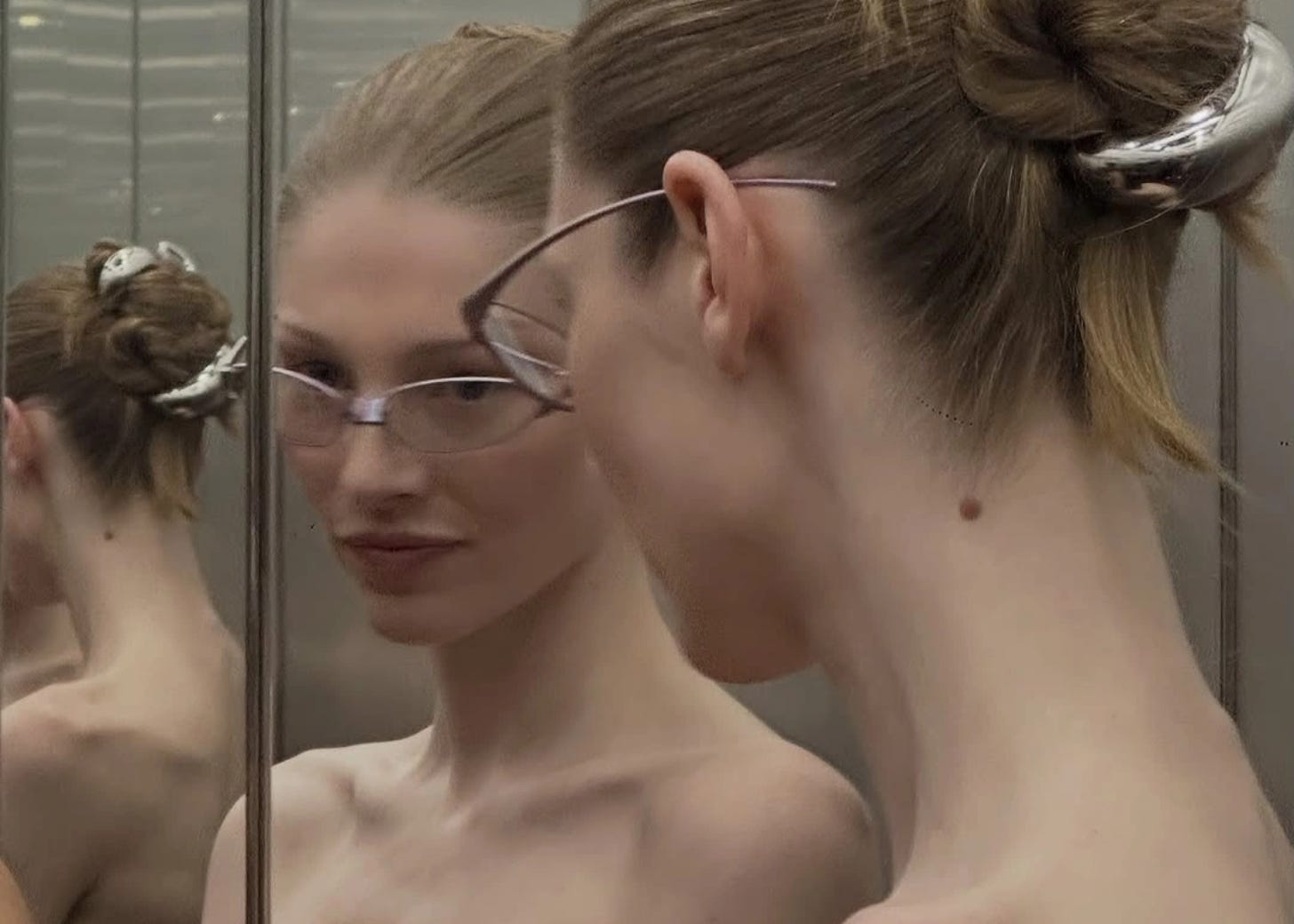
what does it do to a person to look at herself in the mirror for forty hours a week?
i have been wondering this for years.
mostly because i spent ten of them as a competitive dancer, staring at myself in a mirror for enough hours that i am no longer entirely convinced i stopped when i left the studio.
the counts are gone. most of the choreography is gone. the particular experience of trying to inhabit a body while simultaneously standing outside of it, taking notes? fiercely intact.
so when a luminous, long-limbed, structurally flawless ballerina followed @overdressed on instagram, i took it as a sign from the universe.
i did the normal thing and asked a near-stranger if i could interrogate her about her leotards over coffee.
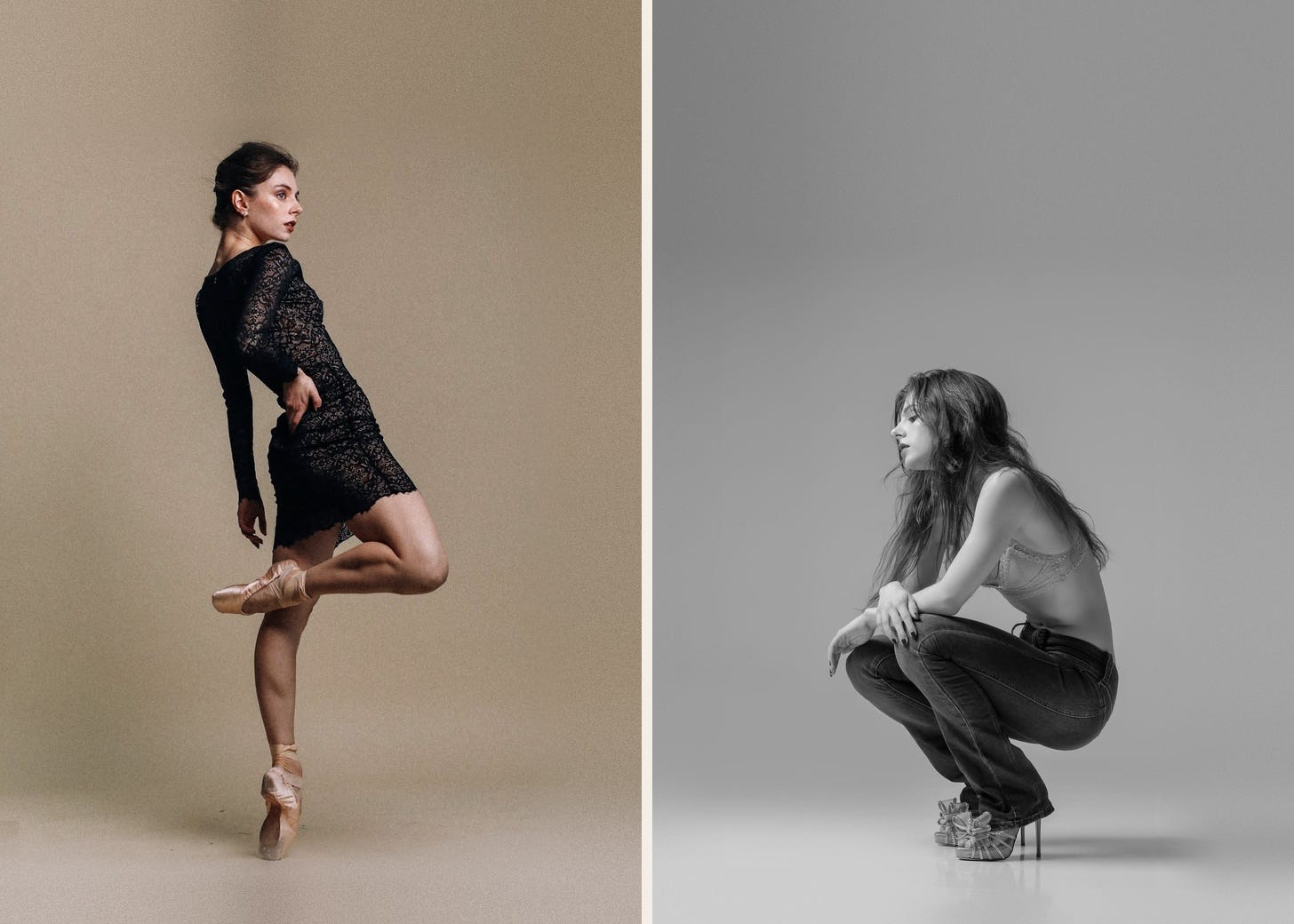
her name is nikita boris — a soloist now in her seventh season with cincinnati ballet. she has been dancing since she was three, when her mother put her in a movement class and she asked, more or less, to speak to the manager. she wanted the real thing. by five she had a russian ballet teacher.
i told myself it was research. but if i’m honest, it was not entirely research. i wanted to know whether forty hours a week in front of a mirror had done to her what it had done to me.
nikita, unprompted, answered with the job description. “our job as dancers,” she told me, “is to show up every day and stare at ourselves in a mirror and be nice to ourselves. which is impossible.”
she said it without a flicker. no sigh, no pause for sympathy, no apparent need for any. which is how i knew she meant it. i assumed we were headed somewhere profound about bodies. but alas, we were headed toward straps.
“if you have a bad leotard on for class, it ruins the class.” and then, in case i had failed to grasp the severity of the situation, she repeated: “it ruins the class.”
a wardrobe malfunction, in reverse
if you were here last month, you know where i’m supposed to go with this.
i wrote about clothes that are criminally needy, the ones that bill your nervous system in tiny increments, and a strap that slides is a textbook case. guilty. next.
except nikita wasn’t describing the strap.
none of it hurts, exactly, and none of it stops her dancing. it is a wardrobe malfunction in reverse: the leotard works fine. her attention is what breaks.
because a bad leotard asks to be thought about. it sits open in the background, quietly eating memory, until it gets checked. and the only place to check is the one place she now can’t stand to be.
“i’m gonna want to stay as far away from the mirror as possible,” she said. “i’m not going to focus on the technique i want to focus on.”
as a woman who has never once stuck to her own interview questions, i abandoned mine here. we were not talking about leotards anymore. we were talking about attention: who gets it, and what takes it.
ballet asks for a body awareness most people never get near. where the hip sits. how the weight falls through the standing foot. what the left shoulder is doing behind your back while you attend to something else. this is information, and she needs all of it.
but the mirror offers a second channel, and it sounds almost identical. not where is my hip but how does my hip look. awareness is the dancer inside the body, taking readings. surveillance is the dancer outside it, keeping score.
it’s a pas de deux nobody choreographed: her, and the her in the glass.
nikita does this for a living. every morning starts at the barre, in front of the mirror, working up from the simplest exercises until her body is ready for the day. the standard she is measuring against is perfection. some mornings the warm-up goes well. on the mornings it doesn’t, she gets to watch it not go well, in real time, from every angle.
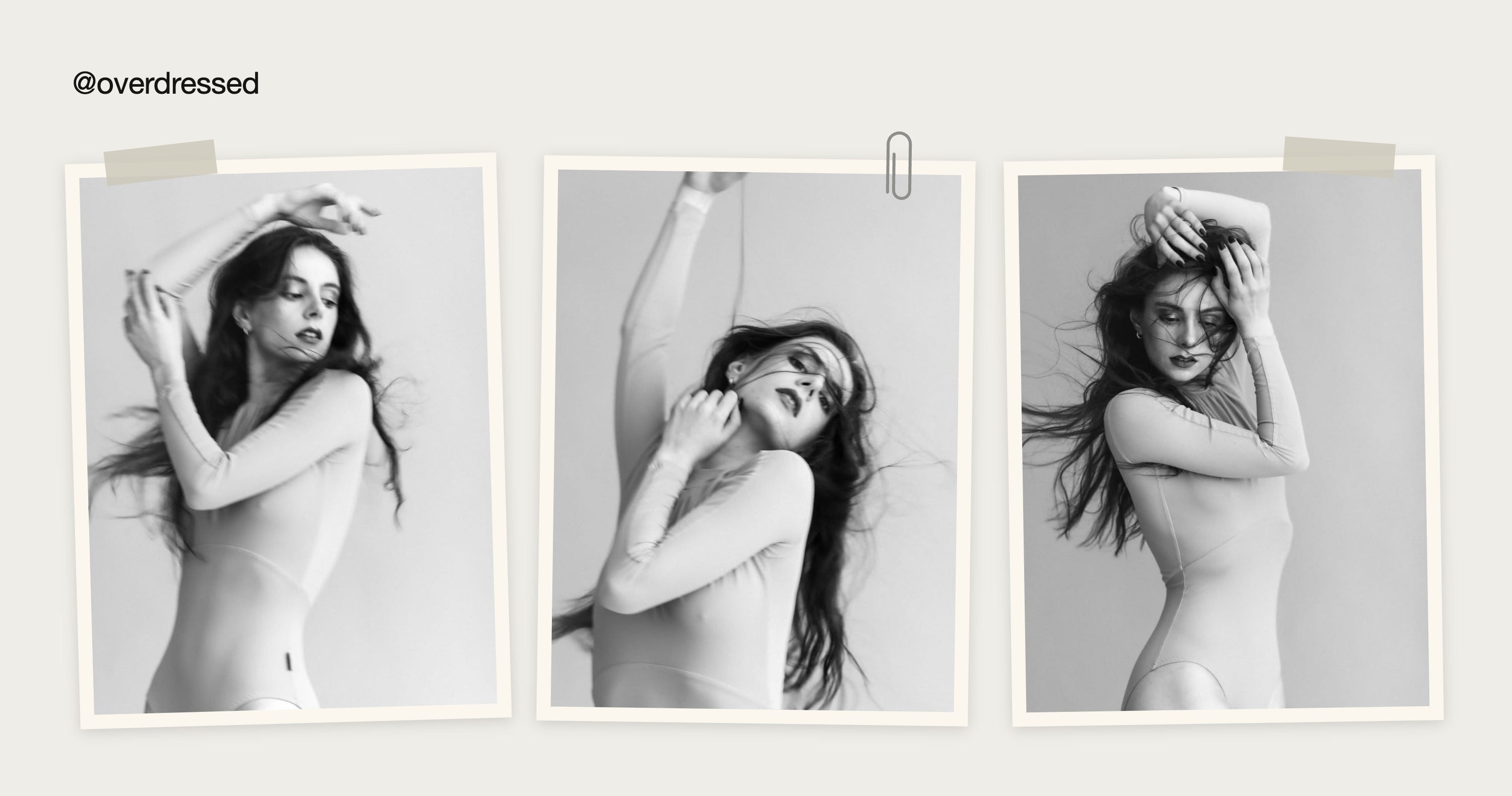
none of this came out as a confession, i should say. nikita has a magnetism about her, and a fire, and she talks about the mirror the way a pilot talks about weather: a condition of the work, to be read and flown through.
“we’re not robots,” she said, and that was that.
the swimsuit + the math test
naturally, i went looking for the research. and i found a study from 1998.1 vintage, technically. it has aged considerably better than anything i wore that year.
researchers sent people into a dressing room alone. nobody else in the room, nobody who would ever see them. half tried on a swimsuit, half tried on a sweater. then, still dressed, they took a math test.
the women in swimsuits did worse.
the men in swimsuits did just fine.
sit with the setup for a second. no audience, no judge, no ex. just a woman, a mirror and a garment, and she lost points on a math test.
before anyone throws their swimsuits into the sea: the swimsuit didn’t make her worse at math. monitoring how she looked did. most of us were taught to inspect ourselves long before we were taught algebra, and inspection runs on the same attention as everything else we’re trying to do.
but a habit we were taught is a habit we can retrain. this is one way the mirror can go, not the only way.
nikita is the proof. a bad leotard still opens a second tab for her. but she has spent a lifetime in front of a mirror and come out the other side able to look straight at herself and keep dancing. the same glass that trains a critic can train something better.
and if you are a chronic tab mismanager — you know who you are, and so does your laptop fan — you already know the second tab never closes itself. someone has to close it on purpose.
over the last year, closing it has become something of a specialty of mine. i have tried the effectively unhinged methods. i named the negative voice in my head cindy.2 i have talked cindy off a ledge. i have cut cindy off mid-sentence when she grabbed the megaphone. all recommended + highly effective, for the record.
but there is a cheekier method, and it starts in your closet:
single-tab dressing · noun
sin·gle-tab dress·ing | ˈsiŋ-gəl ˈtab ˈdre-siŋ
the practice of choosing clothes that close the critic’s tab.
to be clear, the second tab is not the mirror. looking is allowed. some outfits practically drag you toward your reflection out of admiration, and the correct response is to go.
the second tab is cindy’s. it opens the moment a glance turns into an inspection, and she always gives herself away. your hands start going back to a strap or a hem that was fine. and when you catch your reflection, you see parts instead of a person: a stomach, an upper arm, the strap again. the critic doesn’t see you. she sees inventory.
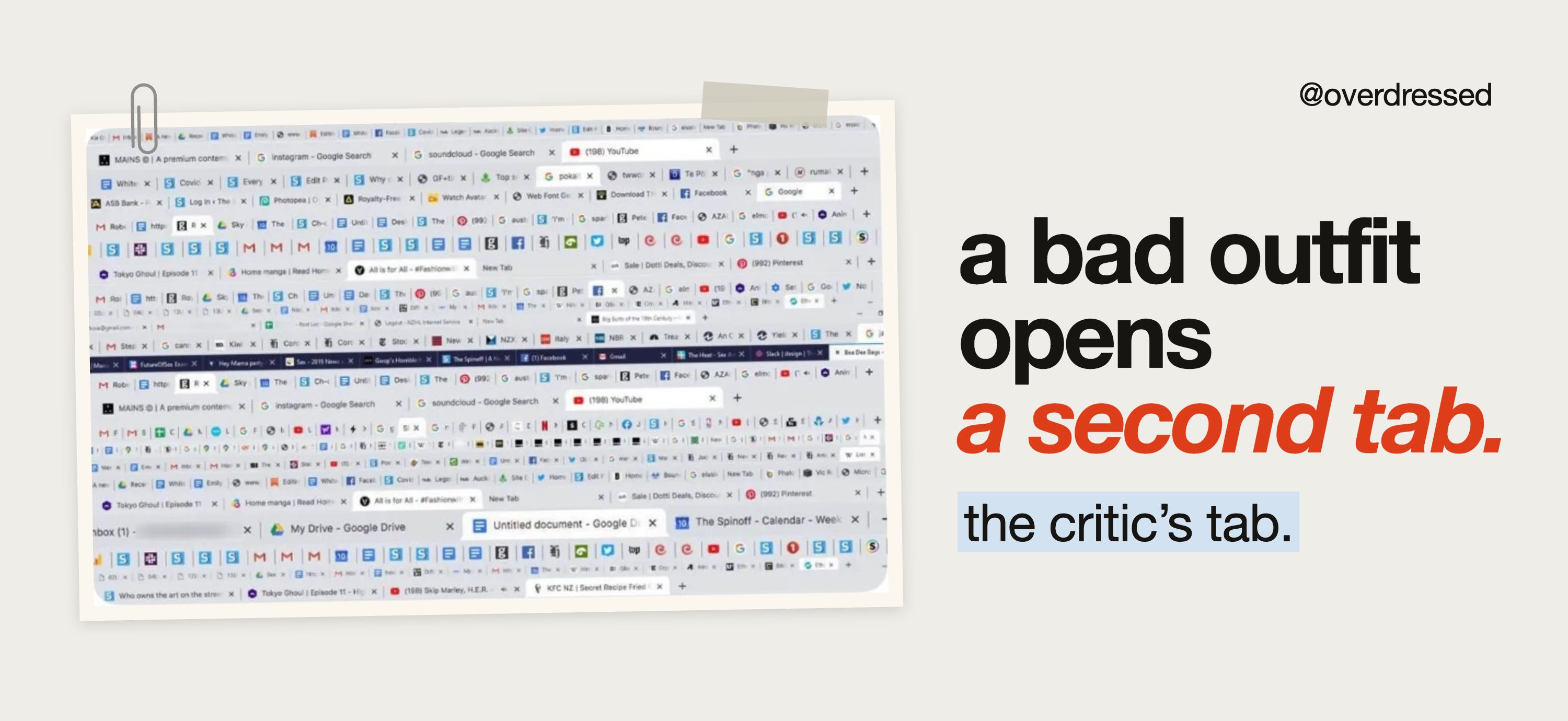
a closed tab is the opposite: you see a whole person, and go back to what you were doing. “if there’s no thought of, oh my gosh, i don’t like what i’m looking like in the mirror right now,” nikita told me, “then you can just really focus on the movement, and enjoy what you’re doing, and be present in your dance.”
which is why single-tab dressing is not minimalism. it is not a capsule, a uniform or a vow of beige. (thank god). a spectacular, unreasonable dress can return you to your body because you feel so good in it that the critic has nothing to add. a perfectly sensible t-shirt can cost you the afternoon because you are adjusting it every four minutes.
comfort is not the metric. interference is.
and should anyone call that attention-seeking, nikita has her answer ready. “it’s not for the attention,” she said, with some heat. “it’s for you.” she’s right. it is also entirely about attention. hers. she intends to keep it.
performance-wear, revised
in the activewear aisle, performance-wear means fabric that wicks sweat and promises a faster mile. it is engineered for the body. nikita’s is engineered for something else.
every day, it gets stress-tested in front of a wall of mirrors by a woman trained since the age of three to notice a millimeter. that isn’t a fitting room. it’s a laboratory. so i asked for the findings.
according to nikita, it doesn’t disappear. it does a job, and her favorites create three different types of energy. each one translates straight to your closet:
1. it lends you nerve.
her most-loved leotards are velvet hand-me-downs, passed through three generations of cincinnati ballet. one has straps so stretched she has to tie them: a garment in hospice, which she reaches for constantly. of a trash bag of castoffs from a friend at american ballet theatre, she said: “maybe this is giving me some of her energy.”
pull one on and she isn’t alone at the barre anymore. the velvet has gone soft from other women’s hours in it, and it gives wherever she gives. she dances like someone with backup.
in your closet: the inherited, the vintage, the friend’s castoff. wear it on the days you need more confidence than you’ve had time to make yourself.
2. it casts you.
she picks by mood. maroon, long sleeves and a high neck when she wants to feel striking. pale pink on swan lake days. “it might sound ridiculous to some people,” she said.
it didn’t sound ridiculous at all. in the maroon, her chin comes up and she takes the front of the room. in the pale pink, everything gets lighter: the wrists, the neck, the landings. nothing in the room has changed except who walked into it.
in your closet: decide who the day needs before you decide what to wear. once the casting is settled, cindy doesn’t get a vote.
3. it moves with you.
for one of this season’s new works, she wears something deceptively simple: blue and yellow, with a layer of mesh beneath. on stage, “it just moves like water.”
and when the costume moves like water, so does she. the arm reaches a little further because the fabric is already going there. the turn lands softer. the costume stops decorating the movement and joins it, and she dances bigger for it.
in your closet: bias-cut silk, a sheer layer over something solid, a skirt with enough fabric to command an opinion. walk, sit, reach for a high shelf. if it comes along gladly, it’s a partner.
last month i wrote about the floor: clothes that stop taking. this is the ceiling: clothes that give. or, as nikita put it: “if you have a nice outfit and you feel beautiful, it breaks down some of the judgment. you can’t make the effort and tell yourself you’re not worth it. not at the same time.”
that is the impossible part of the job description, handled before she reaches the barre. not with affirmations. with a red leotard and the right earrings.
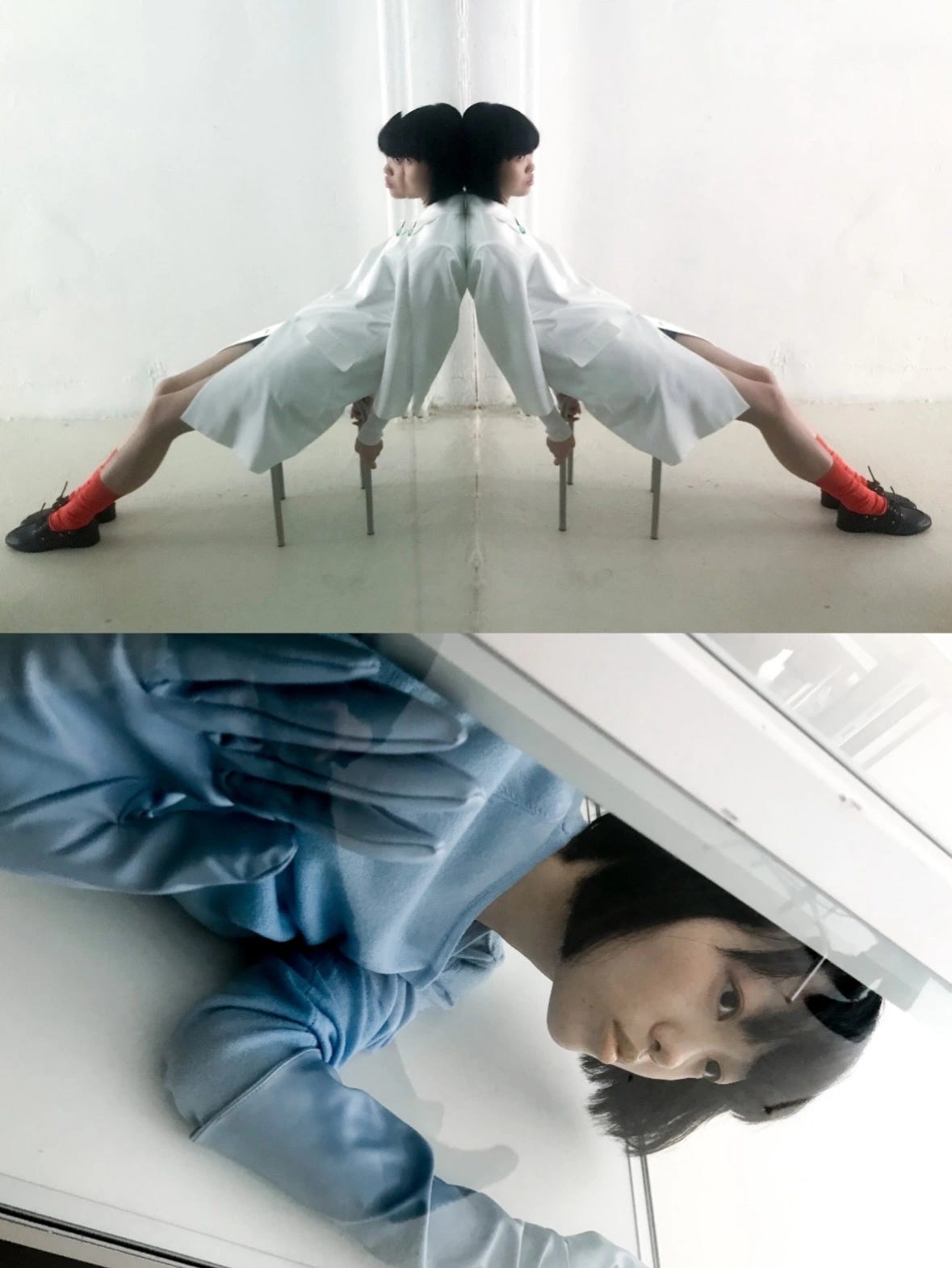
the same outfit, twice
you don’t need a barre to have a mirror. these days, the mirror follows you.
it’s the little rectangle of your own face in the corner of every video call, which you have been watching instead of your colleagues since roughly 2020. it’s the front-facing camera that ambushes you when you meant to photograph the view — handing you an unsolicited audit of your chin.
we are not performing choreography. we are writing, presenting, on a third date, parenting, sitting in a meeting trying to have one clear thought. the stage is smaller. the audience is the same — it’s you, babe.
and you know the version of you who shows up when nothing is tugging. she’s funnier. she finishes her sentences. she is not a better body. she is the same body, finally running on one tab.
most dancers commute in activewear. nikita commutes in an outfit: considered, the kind you’d notice from across a room (i did). at the studio she trades it for pink tights, a leotard, a skirt and a necklace, and spends the day being looked at, mostly by herself.
and at the end of the day, she changes back.
“not nikita the dancer,” she said. “me.”
i wore my hair in a bun the day we talked — for her, i said. “oh, i love it,” she said, and we moved on.
it took me until the walk home to see what i’d done. years out of the studio, and i had still dressed as a dancer to go and meet one.
so. what does it do to a person to look at herself for forty hours a week?
i went in wanting to compare notes. i came out with an answer. it makes you very, very good at looking. that’s a skill, not a scar. and like any skill, what you point it at is up to you: the parts or the person.
nikita chose the person. walking home in a bun i hadn’t thought twice about, so had i.
more about me

i spent years in market research, then as a cmo, learning why women buy things. now i study what happens after: what we put on, why, and what it does to us.
overdressed is for the woman who wants more from life and suspects her closet is in on it. more energy. more pleasure. more of herself in the room.
if that’s you, pull up a chair.
more to read
nikita’s essay is the ceiling. if you’re new here, start with the floor: your closet is draining your life force, on the clothes that quietly bill your nervous system, and what happens when you stop paying.
more chairs at the table
you know one. she watches herself on zoom instead of the meeting. send her this. and if three of your friends pull up a chair, your next month at the table is on me:
the study is called “that swimsuit becomes you,” which is an exceptional title for a psychology paper. fredrickson et al., 1998, if you’d like to read it in a sweater.
a formal apology to any cindys catching a stray. the name was chosen for its audacity, not its accuracy.