


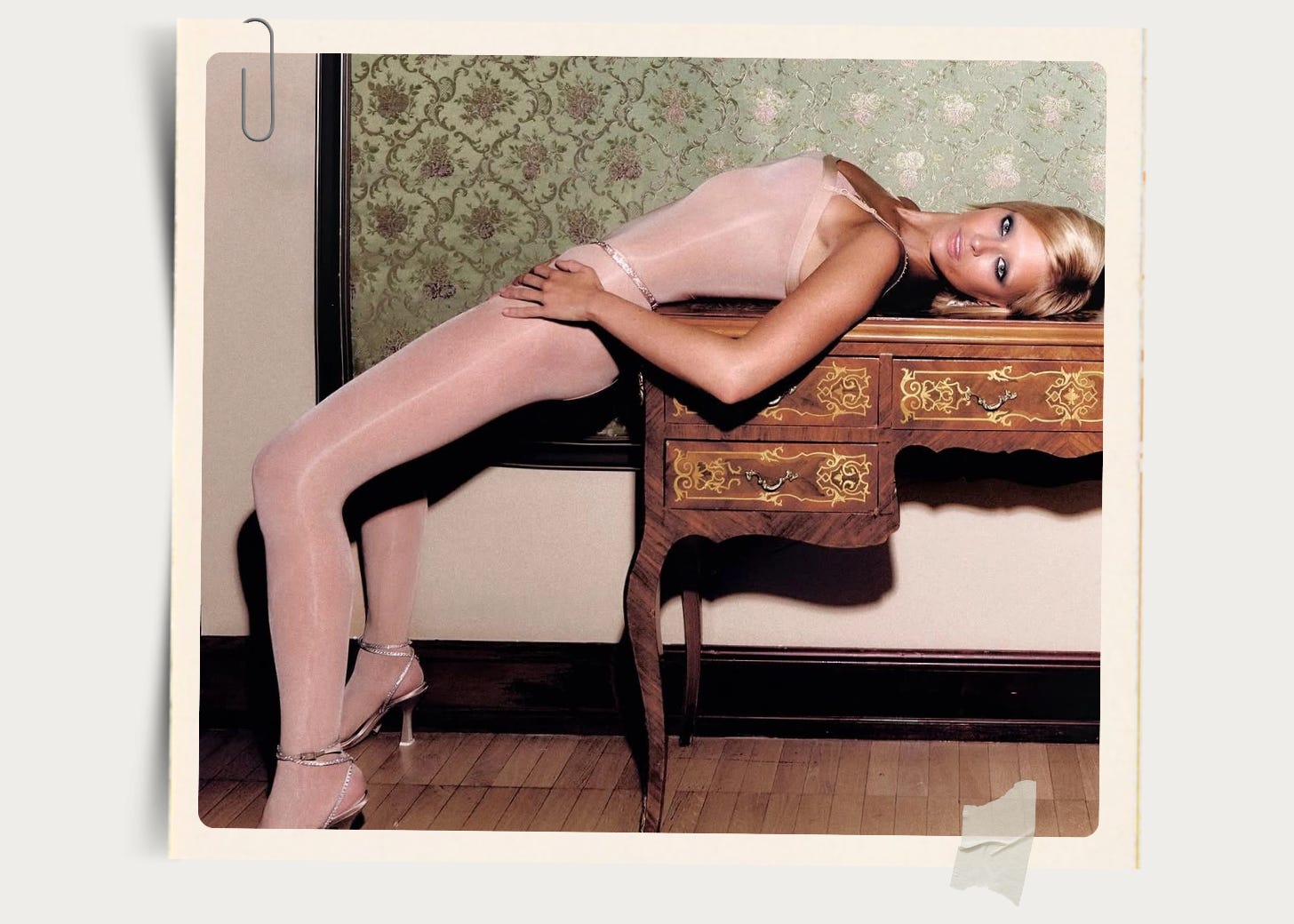
it took almost an entire year of not buying clothes for myself to understand research i helped conduct nearly seven years ago.
i should have been smarter than this.
at the time, i was working for one of the world’s largest market-research firms. a major american womenswear brand wanted to understand how women actually lived inside their clothes.
we studied this like a new religion for months. i presented the findings. presumably, someone important took notes.
one pattern was difficult to miss: when women imagined improving their wardrobes, their attention went overwhelmingly toward the statement layer — the exciting piece, the visible upgrade, the thing that promised immediate transformation.
and then i spent the next six years behaving as though i had learned absolutely nothing.1
in my defense, dopamine is persuasive. and trends are seductive little c*nts. together, they can keep a woman so preoccupied with what her wardrobe is missing that she never stops to ask what the wardrobe she already owns is actually doing to her.
so i kept improving the part that was most exciting to improve: the statement layer.
a more interesting dress. a more current shoe. another wow-worthy jacket with a complicated reason to exist. each purchase produced a shiny flash of possibility — the sense that my wardrobe, and therefore perhaps my life, had just become incrementally more fabulous.
sometimes it had!
but after a year without that flash, my eyes adjusted.
without anything new arriving to distract me, i had to live with my wardrobe exactly as it was. wear it. repeat it. notice which clothes made getting dressed easier and which ones quietly collected tax. which garments returned energy. which demanded constant negotiation. which beautiful pieces expanded my life — and which merely expanded the number of objects inside my closet.
the shopping fast did not make me less interested in fashion.
but it did reveal what the constant arrival of new clothes had been concealing:
i think most women are trying to improve the wrong part of their wardrobe.
i certainly was.
the evidence appeared on the roof of my apartment building.
a few weeks ago, i was lounging there in a silk dress, crisp white hotel robe, slippers + vintage sunnies when one of my girlfriends found me.
to be clear, i hadn’t gotten dressed for the roof. quite the opposite: this was what i had thrown on because i had no intention of getting dressed at all that day.
she looked at me for a moment.
💬 “i cannot believe this is your baseline.”
dear reader, upon reflection… neither could i!
not because the outfit was particularly elaborate. it was a robe and slippers! by most accepted definitions, i was wearing pajamas — albeit confidently — in public. but they were excellent pajamas, and underneath them was a silk dress requiring no styling, no complicated undergarments + almost no meaningful participation from me.
the silk dress handled the silhouette. the robe supplied drama. the sunglasses added voltage. the slippers were, mercifully, just slippers.2
and yet, there i was. comfortable. and perceptibly myself.
that very day, i had listened to my friends’ podcast about raising your baseline minimum standard. so when baseline made another buzzy appearance, it felt less like coincidence than aggressive thematic development.
the universe is not always subtle. sometimes it sends your girlfriend upstairs to conduct an unsolicited wardrobe audit and circle the thesis in red.
and she was right.
the point was not that the outfit was remarkable. it was that, for me, it had become ordinary.
it was not the height of what my wardrobe could do.
but it was evidence of where the floor now sat.
when we talk about raising our standards, we tend to imagine a stretch — an upward, tippy-toe reach.
the bigger life. the better relationship. the more disciplined routine. the spectacular outfit.
standards become synonymous with aspiration: the highest level we might reach once we are focused, healed, organized + adequately caffeinated.
but your highest expression is not your standard.
your standard is what remains when motivation leaves the room. it is what you tolerate repeatedly. it is the decision made automatically — before your more aspirational self has logged on for the day.
this is why buying a dress that practically qualifies as an event does not necessarily improve the lived experience of your wardrobe. it may raise the ceiling. but if it requires shapewear, dry cleaning, a very specific heel + the abdominal conditions of a minor religious fast, it is not changing what happens on an average day.
this does not mean we stop buying the dress.
(!!) don’t you dare leave here spreading rumors that i have declared a spiritual war on fashion.

the spectacular moments remain spectacular. i still want clothes that make me gasp. i still want outfits that take three hours, six opinions + a minor feat of structural engineering to construct.
but i simply no longer want feeling good to depend on my ability to produce one.
low-capacity days exist. so a closet contingency plan pays dividends.
this is where the minimum viable outfit comes in.
minimum viable outfit (mvo)
noun
min·i·mum vi·a·ble out·fit | \ ˈmi-nə-məm ˈvī-ə-bəl ˈau̇t-ˌfit
the smallest amount of effort required to cross from merely clothed into recognizably yourself.
the minimum viable outfit is not quite a capsule wardrobe. it is not necessarily a uniform. it is an outfit formula built around a few foundational pieces that take almost no thought to style + reliably return more energy than they consume.
these are the clothes you can put on and then stop thinking about. you can sit down, eat lunch + move through the day without tugging, smoothing or checking your reflection from the side.
the test is surprisingly unforgiving: can i pair this with one of the least demanding things i own and still feel intentionally dressed?
for me, the answer increasingly lives in pieces that do the styling before i have to.
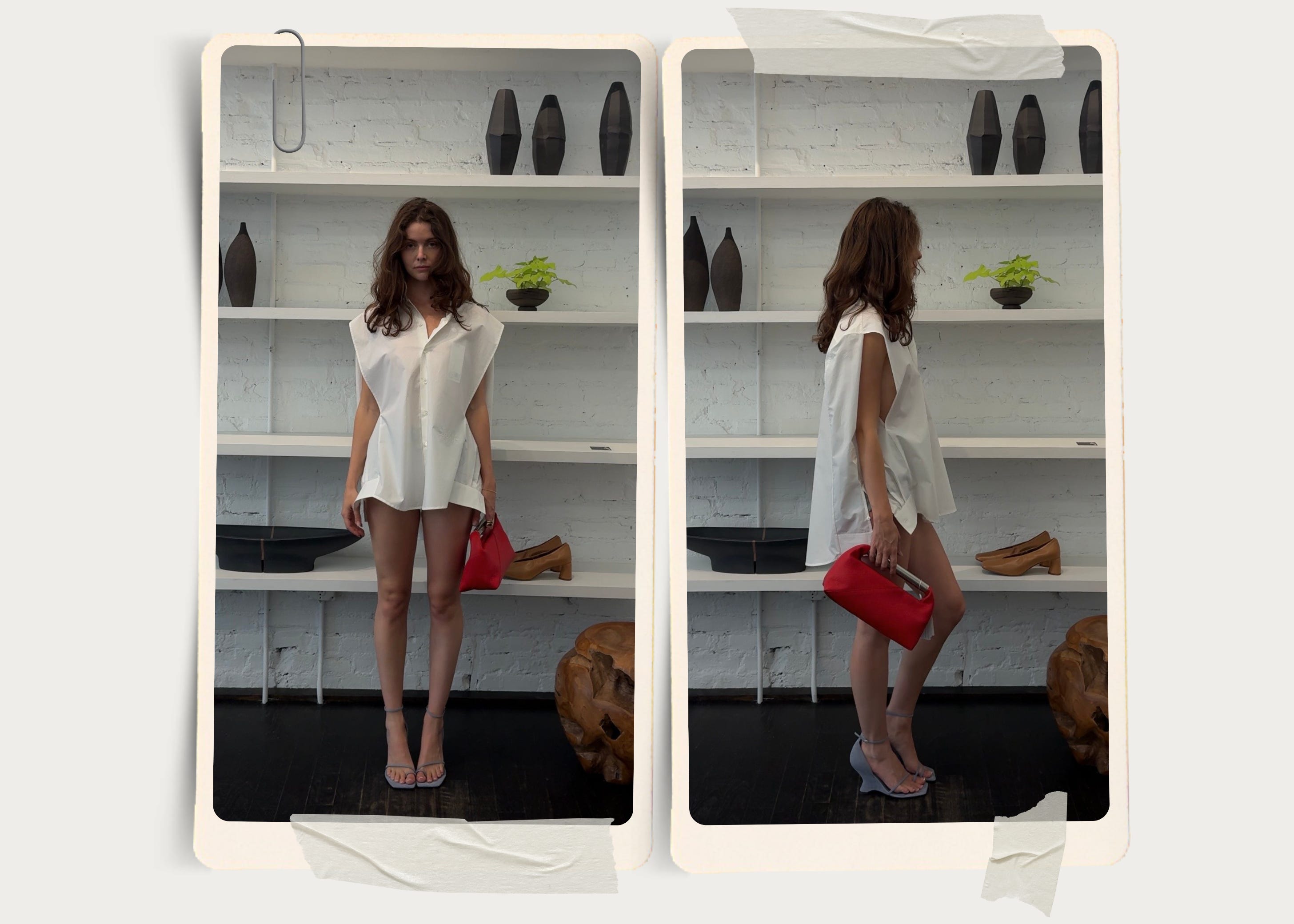
the cotton poplin shirt by mm6 maison margiela (pictured above) begins as a shirt, but the proportion shape-shift it into a look. pull it over micro-shorts, add a shoe + leave the house. the shape has already made the look interesting. anything added after that is recreational.
the black mini dress by mm6 maison margiela earns its place by refusing to complicate matters. the close fit creates a clean line; the black works with every shoe i would realistically reach for. tall boots when i want weight. a small heel when i don’t. the mood can change without requiring the entire outfit to be reconsidered.
the silk satin u tank + everywhere pant by enza costa eliminate the part where i stand half-dressed wondering whether two garments have any business being together. they look polished — yet the relaxed trouser + elastic waistband maintain a private allegiance to sleepwear. together, they are the outfit. separately, the tank can go with jeans and the pant can take an asymmetrical t-shirt. zero coordination required, several outfits acquired.
this is the division of labor i am after: a foundation that handles both comfort + point of view. everything else gets to be easy.
that is your minimum viable outfit.
not your lowest standard. the standard built to survive an ordinary day.
a good foundation earns its place through repetition. the floor of your wardrobe is shaped not by what a garment promises at purchase, but by what happens every time you wear it.
which raises the less flattering question: what has been lowering the floor in the first place?
i have identified two primary suspects.
culprit no. 1: the clothes giving absolutely nothing
i like to think we’ve warmed up to each other by this point, so allow me to be blunt: i do not fear this is an informal indictment of sweatsuits.
sweatpants are wonderful at their assigned job. they are warm. forgiving. emotionally available. they have seen us through illness, heartbreak, long-haul flights + several seasons of television we would prefer not be entered into the historical record.
but sweatpants have terrible ambition for us.
left unsupervised, they will happily become the uniform of a life conducted entirely from the horizontal position. they ask nothing. they expect nothing. they have never once looked at you and inspired, perhaps we should go somewhere.
and sometimes, that is precisely the medicine. there are days when the most nourishing thing you can wear is the oldest shirt you own and absolutely nothing containing a button.
the problem begins when comfort stops being a conscious choice + becomes the automatic one.
you know the outfit. you put it on because you have neither the time nor the spirit for anything else. three hours later, you catch your reflection and feel yourself retreat another half-inch from the day. nothing is “wrong.”
the clothes are present.
but you are becoming less so.
so, fine. the sweatpants are mostly innocent. (but i would like them questioned in connection with the disappearance of several women i know.)
the minimum viable outfit is not an attempt to perform attractiveness at all times. god forbid a woman encounter her own mailbox without first achieving visual excellence. it simply makes the kind of comfort that still feels like you as easy to reach for as the kind that makes you disappear.
culprit no. 1 lowers the floor by making disconnection the path of least resistance.
culprit no. 2: the clothes that are criminally needy
our second suspect favors the opposite method: these clothes refuse to let you think about anything else.
the shirt that makes you sweat before you have done anything worth sweating over. the trousers you pull at every time you stand. the dress that fits beautifully provided you do not sit, eat, or participate too enthusiastically in being alive.
the fabric scratches. the neckline migrates. the button has become an ongoing threat. the “basic” only works with a bra you hate + a level of vigilance no cotton tank has earned.
these are the energetic leaks…
i suspect a piece in your closet already came to mind. identify the garment + its offense in the comments — let’s compare notes + get smarter together.
none of them is catastrophic. that is how they survive. they technically fit. they can technically be worn. no single irritation feels serious enough to justify removal, so they remain in circulation, billing your nervous system in tiny increments throughout the day.
adjust. conceal. brace. check.
wonder whether the problem is the garment or your body.
somehow arrive at the more punishing conclusion.
a garment does not need to ruin your life to lower its quality. sometimes it only needs to keep you thinking about it.
we hold on because it was expensive. because it almost fits. because it looks excellent while we remain perfectly still. because one day we may become the woman with the patience, posture + shallow respiratory pattern required to make it work.
but if a shirt makes you spend the entire day thinking about the shirt, it is not a basic. it is a push notification with sleeves — consider this permission to put it on dnd.
some clothes lower your floor by making you disappear inside them. others make themselves so relentlessly perceptible that you cannot fully appear anywhere else.
one gives nothing.
the other never stops taking.
either way, you are the one paying for it.
here is what i understand now that i did not understand seven years ago:
a closet is full of tiny, repeated decisions about what we will accept, excuse + continue making room for.
and a standard raised inside the closet rarely remains confined to it.
stop confusing technically fits with belongs in my life, and the distinction becomes difficult not to recognize elsewhere. suddenly, you can see the friendship surviving entirely on history. the opportunity collecting more energy than it returns. the relationship held together by timing, potential + emotional shapewear.
the silhouette is familiar.
this is not to suggest that donating one vindictive trouser will cause the universe to overnight you a better life. i have reviewed the shipping policy. no such guarantee exists.
but raising a standard changes your relationship to accommodation. you spend less energy adjusting yourself around what does not support you. you stop treating discomfort as the inevitable cost of having something beautiful. you become quicker to recognize the difference between a difficult moment + a fundamentally hostile waistband.
perhaps this is what energetic alignment actually looks like: your actions no longer contradicting what you say you deserve.
so yes, keep raising the ceiling. buy the spectacular dress. construct the extraordinary outfit. become visible from space for no occasion whatsoever.
but do not mistake extraordinary effort for the only route to your highest self.
the ceiling may show you who you can become.
but raising the floor makes her easier to reach.
it took a year of buying nothing to understand what i had been trying to purchase all along:
not more possibility.
more access.
returning to myself no longer required an occasion.
it had become my baseline.
a small note on the idlewild links: this post is not sponsored. tessa clark, the woman behind idlewild, is my friend + someone whose eye i deeply trust. we’re heading to new york fashion week together this week, and i’m delighted to send a little love toward the extraordinary independent shop she has built here in cincinnati.
the links are plentiful. the affection is real. the invoice does not exist.

emotionally, my footwear has only two settings: heel and slipper.
ps: yes, i put the footwear discourse in the footnotes. thematic integrity matters ✨
Sarah, you wise goddess! Love all of this, even though it definitely brought up some difficult truths! It left me thinking a lot about the version of me that IIIII think I deserve when left to my own devices versus the version I present to others and want others to think of me as.
I realized there is something almost actively self-sabotaging in the distinction for me. It ISN’T that I actually care less about what I wear when no one else is around — there is almost a tiny gremlin in me that WANTS Alone Me to walk past the floor-length mirror in the apartment wearing the T-shirt and sweatpants I don’t particularly like, catch my reflection, and cringe. Like: Yes, correct. That IS who Me Alone deserves to be. Meanwhile, Me In the World gets color, ridiculous accessories, interesting silhouettes — visual evidence that I am someone worth noticing and delighting in.
I wonder if that division can become both a weird form of self-punishment AND protection. If I reserve the fullest, most intentional version of myself for being witnessed, I never have to confront whether I believe I am worth that same effort without an audience. There is a perceived safety in keeping the floor low: I can always tell myself that the diminished version isn’t the “real” presentation of me because I wasn’t really trying. The sweatpants become almost plausible deniability — I don’t have to risk the possibility of looking at myself, alone, having actually extended care towards myself and deciding still I don’t like what I see.
Which absolutely makes your idea of raising the floor feel all the more profound. There is something almost radical about refusing to make self-regard conditional on witness. About consciously deciding that Alone Me is not the person who deserves the leftovers.
And THEN, there is my separate but related realization that I am an absolute SUCKER for the fact that EVERYTHING has a T-shirt. Went somewhere? T-shirt. Supported a cause? T-shirt. Saw a show? T-shirt. Volunteered for something? T-shirt. Attended an event whose continued existence I would like to personally validate? Obviously I need the T-shirt. My brain apparently believes that the highest form of solidarity is allowing an organization to turn me into a tiny walking billboard.
The result is that I own — not hyperbolically — upwards of 500 T-shirts, and I would estimate that I actually enjoy wearing perhaps 1/10 of them. Which has me thinking about how much of my closet is designed to tell the story of who I am rather than actually facilitate the experience of being her.
And I think that’s what I find so smart about your distinction between raising the ceiling and raising the floor: the clothes that best REPRESENT us and the clothes that best RETURN US TO OURSELVES are not necessarily the same clothes. I have apparently spent years acquiring receipts for an identity when perhaps the more interesting question is: what do I reach for when nobody needs proof?
Anyway, I fear you may have just initiated a deeply upsetting T-shirt reckoning in my household. My wife will be thrilled. 💕
The minimum viable outfit is such a good concept. Not a uniform, not a capsule, but a baseline that lets you feel recognizably yourself even on low-capacity days.