


there is a photograph from the end of the tibi show that my brain keeps treating as a clerical error.
founder + creative director Amy Smilovic is walking down the runway as dolly parton’s “i will always love you” swells through the room. she is in the center of the frame, hands pressed together, receiving the audience’s applause.
and if you look immediately to her left, there i am:
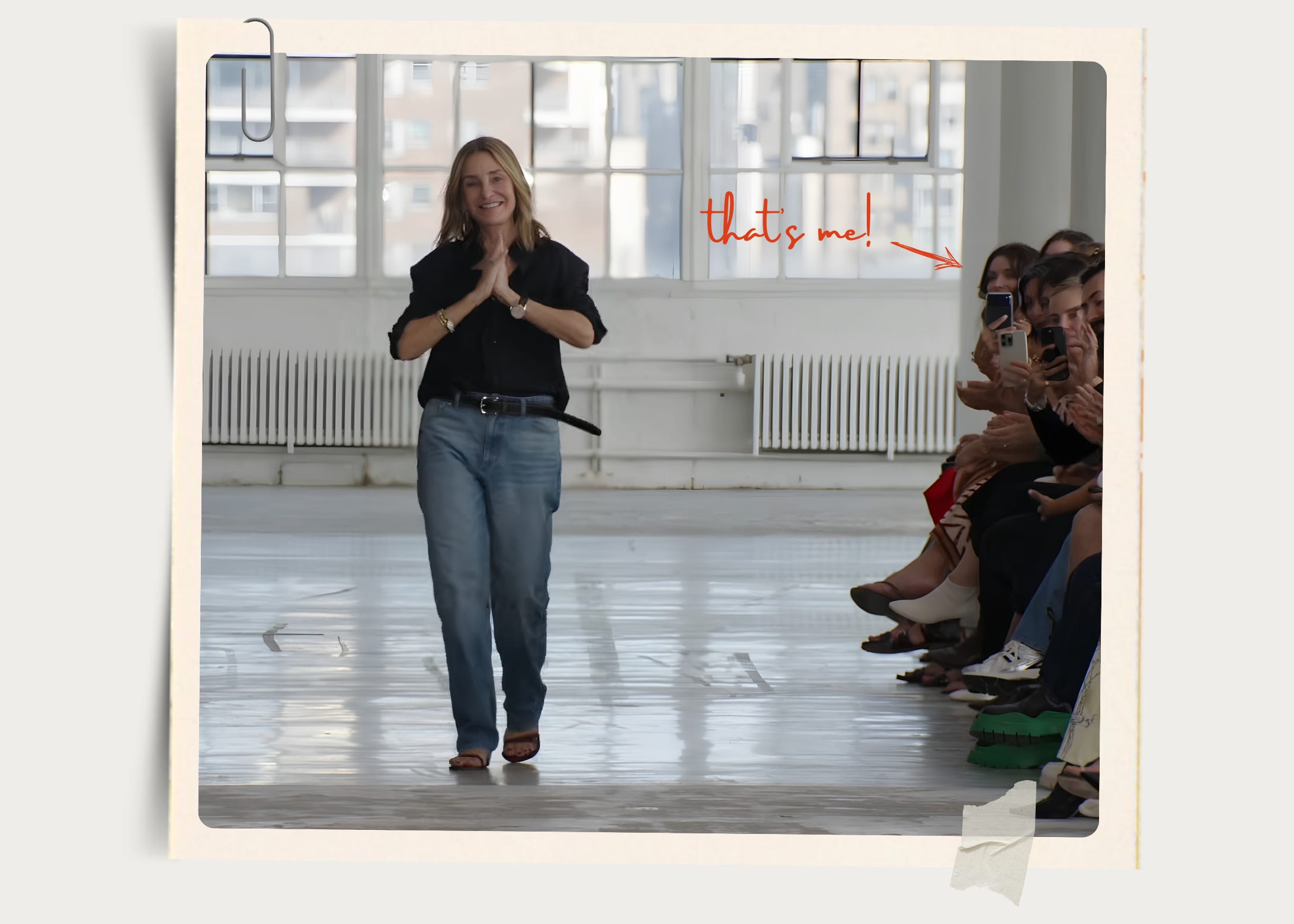
the seat assignment was a-1-1. not merely front row, but the first chair lining the runway with an entirely unobstructed view — the fashion-week equivalent of god pulling back the velvet rope + saying, actually, come sit beside me.
this detail becomes more absurd when i tell you what happened six months earlier.
i had sent tibi a message asking if i could attend their february show. i explained who i was, what i wrote about + why amy’s approach to personal style had rearranged several pieces of furniture in my brain.
i did not ask for the best seat in the room. i did not ask for a seat at all.
i politely inquired begged for the privilege of standing somewhere in the back.
and nothing materialized.
apparently, my first invitation to the tibi show was sent psychically.
the seductive version of this story
there is a very easy way to explain what happened next: i wanted something. i believed it was possible. six months later, i received something better than what i had asked for.
presto, manifestation! 💫
roll credits. purchase journal.
…but that version edits out the most important part of the story: the grey middle between desire + the receipt.
a dress does not travel directly from a designer’s imagination onto a woman’s body. first, there is an idea. something invisible. perhaps a color, a feeling, a woman crossing a street in nashville, a photograph of dolly parton looking soft + formidable at once. then come the sketches, the fabric, the pattern, the fittings, the revisions + the samples. then the runway, the showroom, the buyer, the store. finally, months after the original thought appeared in someone’s mind, a woman walks into a dressing room in cincinnati, pulls the garment over her head + recognizes herself.
we call the finished object fashion.
we rarely discuss the supply chain required to make the fantasy material.
dreams have a supply chain too.
in february, i went to fashion week without a single show invitation. this sounds bleak until you understand that i was too fascinated to be properly embarrassed.
i stood outside the shows instead, watching who entered, what they wore + how the machinery of access seemed to operate. i studied the photographers, the publicists, the seating charts + the tiny invisible hierarchies revealed whenever someone approached the door.
i was not inside the room, but i was in relationship with it.
there is a difference between being excluded from your future + being early to it. at the time, i could not know which one i was.
that is the uncomfortable part of pursuing anything before there is evidence it wants you back: devotion + delusion look almost identical from the outside. you have to continue without demanding constant reassurance that the desire is valid.
so i observed. then i went home and wrote.

meanwhile, a moving truck set the supply chain of this particular dream in motion.
every quantum leap has a paper trail
in august, tessa, the co-owner of idlewild, moved into my apartment building.
we had known each other for more than a decade, but proximity gave our shared obsession somewhere new to go. we speak the same language of fashion — fluently, expansively + with our whole bodies — and suddenly we had regular access to the kinds of conversations that happen when two women with overlapping fixations begin encountering each other at the elevator.
one evening, we were sitting on the roof when we jokingly suggested going to new york fashion week together.
to be clear, neither of us was planning to go.
it was less a plan than two fashion-obsessed women entertaining themselves with the possibility of becoming briefly unreasonable.
then we began asking questions. we reached out to a few people. one opening gave the next thing somewhere to attach. appointments materialized. invitations arrived. the trip began assembling itself with such an eerie lack of resistance that our joke started to feel less like fantasy + more like advance notice.
at some point, we stopped saying wouldn’t it be funny if we went? and started discussing flights.
the joke was no longer a joke.
we call these moments quantum leaps because the visible change appears instantaneous.
one day: outside the shows. the next: holding an invite marked a-1-1.
but the leap had an administrative history. someone sent an email. someone remembered a name. someone trusted a perspective. someone added a seat, confirmed an appointment, forwarded an introduction.
the universe may move mysteriously, but apparently it still requires someone to update the spreadsheet.
the trip did fall into place — but only after we answered each coincidence with logistics. every opening received an email, a follow-up, a calendar invitation, a hotel reservation, a garment bag. what felt spiritual was not the absence of effort. it was the strange ease with which the effort began meeting us halfway.
by the time i reached the tibi show, i had been thinking about this choreography between imagination + execution for months.
then the clothes gave it a name.
pulling on the tibi thread
the spring 2027 collection was inspired by nashville, but it resisted anything as obvious as dressing women like fashionable cowboys. the references had been metabolized. there were plaids, boots, fringe, faded neutrals + flashes of dolly-worthy glamour, but the clothes never lapsed into costume.
fringe created movement without consuming the woman wearing it. shimmer appeared on shapes that could still participate in ordinary life. quiet colors were interrupted by chartreuse, rust, olive + plum. familiar pieces contained one proportion, texture or styling decision that made them slightly strange.
the clothes were pragmatic enough to live in. creative enough to make living feel different.1
and this is the tension tibi has built an entire philosophy around: creative pragmatism. not compromise between imagination + utility, but a refusal to separate them.
the creative pragmatist wants the idea and the infrastructure. the fantasy and the functioning zipper. the spiritual revelation and the spreadsheet that makes it arrive on time.
sitting there, it occurred to me that creative pragmatism is not merely a way to make clothes. it may be manifestation theory in an exceptionally good trouser.
creativity allows you to see a life before it exists. pragmatism asks what that life requires from you today.
without creativity, you become highly efficient at maintaining a life you may no longer want. without pragmatism, you create an exquisite private universe with no shipping department.
the following day, inside the tibi showroom, i watched the two meet.
a showroom appointment begins with selection. we moved through racks of the new collection, touching fabrics + pulling the pieces we wanted to see. then models emerged wearing our choices while we drank coffee, took videos + discussed what might make sense for idlewild.
here, dear reader, fantasy acquired a climate, a closet + a customer.
what had looked like pure instinct on the runway became a sequence of practical questions. what would this fabric feel like on a humid cincinnati afternoon? which proportion would excite idlewild’s customer rather than overwhelm her? what would she already own that could make this strange new piece immediately intelligible? which piece would cause an immediate emotional event + still earn its place in her actual life?
i watched tessa move through those questions using her knowledge of the women she dresses: what they bought last season, what they repeatedly reach for, what is still missing from their wardrobes + which new piece might make everything they already own feel more interesting.
the runway presents a possibility.
the showroom reveals the chain of decisions between wanting it + living in it.
for the first time, the grey middle between desire + receipt had a visible outline.
the spiritual material girl’s dilemma
the spiritual material girl lives under a peculiar suspicion: if she were truly secure, enlightened + aligned, she would not care about the seat, the dress, the invitation or the room. wanting visible proof makes her shallow. enjoying it makes her egotistical. feeling disappointed by its absence means she has failed to detach.
apparently, enlightenment has a dress code — and it is aggressively indifferent.
but i f*cking disagree!
matter is not the opposite of spirit. matter is what gives spirit a body.
every garment in the showroom began as something no one else could see. turning the idea into fabric did not make it less sacred. it made the idea available — to a buyer, to a store, to a woman getting dressed in cincinnati.
and this, i realized, is what amy has done with style itself.
fashion often treats style as innate: either you possess the mysterious gift of knowing what works or you stand helplessly in a fitting room saying, i could never pull that off.
amy takes those vague intuitions + turns them into teachable systems. chill, modern, classic gives a woman language for the sensibility she wants to create. big, slim, skin makes proportion something she can understand + manipulate.
these systems do not tell a woman what to wear. they give her a way to question the beliefs that have been dressing her: that shape is not for my body. that color is too much. i am simply not someone who knows how to do this.
instead of accepting the reflexive no, she can test it — because she’s equipped with the brand’s grammar + therefore, the ability to write herself differently.
that is when the grey middle fully clicked for me.
we treat the stretch between desire + receipt as an ambiguous waiting room. but the grey middle is where desire acquires structure.
longing is not yet a role. so i translated it into a committed practice: observe. write. develop the language. publish. repeat.
none of that resembled seat a-1-1. but by september, the practice had become a body of work, a sharper vocabulary + a perspective that could be useful to a buyer. i was no longer arriving with desire alone. i had a contribution to make.
the practice did not guarantee the seat. it made me capable of participating when the door opened.
amy’s framework moves a woman from i could never wear that to let me understand how.
without realizing it, i had built one that moved me from i am not inside the room to i am learning how to enter it.
a-1-1
i keep returning to the photograph of amy taking her bow. dolly is singing. amy is at the center of the runway. and there i am in the first chair, looking at a scene i had no evidence would exist six months earlier.
the tempting conclusion is that the universe finally said yes.
but the seat was not the moment the dream became real.
it was the moment the dream became visible.
the order had been processing for months: outside the shows, inside the writing, at the elevator, on the roof, in every email + conversation that made the next one possible. what looked like waiting had been construction. what looked like an unanswered message had simply been one route that did not open.
silence is an empty space. so be careful what prophecy you place inside it.
sometimes no is no. sometimes silence is only silence. and sometimes you are not being excluded from your future.
you are early to it.
the spiritual material girl is allowed to love the evidence. she can photograph it, frame it, build an entire essay around the seat assignment. she simply cannot confuse the evidence for the transformation.
the dream was the purchase order.
the grey middle was the supply chain.
a-1-1 was only the receipt.
and receipts, by definition, are printed last.

overdressed + overanalyzed studies how clothes shape our internal lives. idlewild helps women translate that knowledge into a wardrobe they can actually live in.
our ongoing collaboration exists where those missions overlap: exploring how getting dressed can become a practice of greater intention, self-knowledge + pleasure.
read more about what we’re building together →
this is why tibi clicked so indecently well with my minimum viable outfit. an mvo is creative pragmatism at closet scale: a low-effort formula with high self-recognition.
apparently, amy + i were conducting adjacent research into the same urgent question: must a woman suffer administratively to look interesting?
findings: no.
❤️❤️❤️❤️💕🙌
Really enjoyed this!